
- Publisher:admin
- Time:2026-10-10
- Clicks:1
- Source:
The cement products industry is an important part of the building materials sector. It also faces challenges related to resource consumption and carbon emissions. Under global carbon neutrality goals, the concrete pole industry is undergoing a green transformation from raw materials and production processes to product lifecycles. This article discusses sustainable manufacturing paths for concrete utility poles.
1. Green Standards for the Industry
In January 2026, the group standard T/CMEPCA 145—2026, Technical Specification for Green and Low-Carbon Manufacturing of Concrete Poles, was published. It specifies terms and definitions, basic requirements, raw material requirements, production process requirements, energy consumption and resource utilization requirements, pollutant emission and control requirements, and carbon emission calculation and management requirements.
In the same year, T/CMEPCA 193—2026, Technical Specification for Green and Low-Carbon Manufacturing of Annular Reinforced Concrete Poles, was issued. It further details green manufacturing requirements for annular reinforced concrete poles used in transmission and distribution lines.
These standards provide practical guidance for pole manufacturers and a basis for customers and tender authorities to evaluate environmental performance. The establishment of a standard framework means green manufacturing is moving from voluntary action to a shared industry norm.
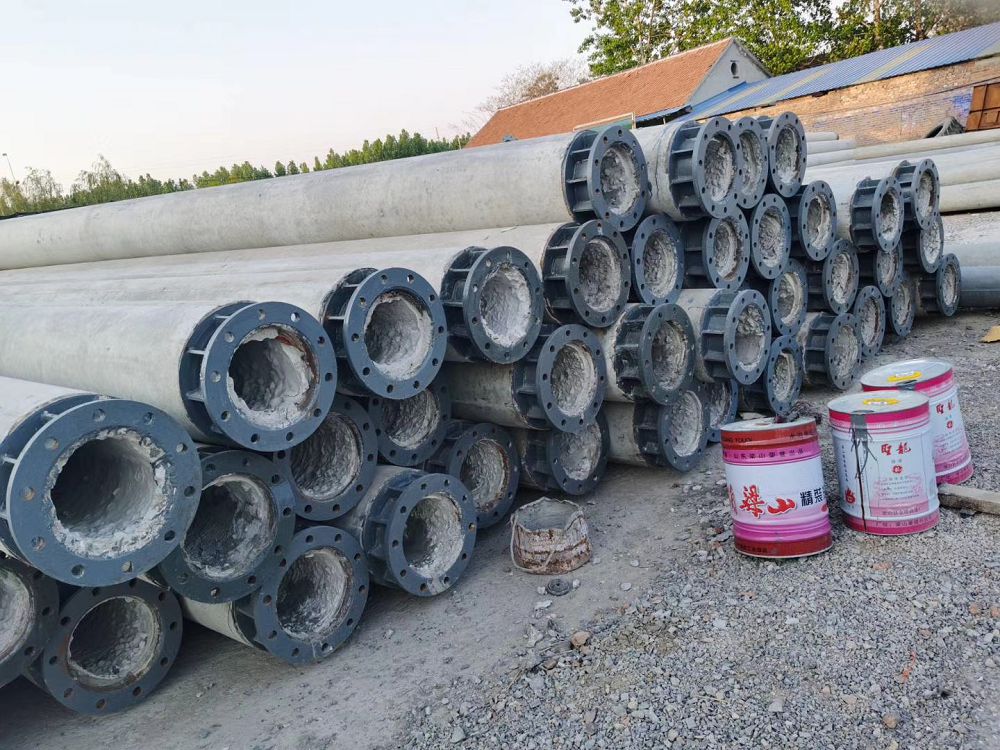
2. Green Substitution of Raw Materials
Cement is the most carbon-intensive raw material in concrete poles. Producing one tonne of Portland cement emits roughly 0.46 tonnes of CO₂. Reducing cement content or using low-carbon binders is therefore a primary direction.
Supplementary cementitious materials. Fly ash, slag powder, and silica fume can replace part of the cement clinker. These industrial by-products can reduce carbon emissions and improve workability and durability. Fly ash particles are spherical and can improve flow. Slag powder has latent hydraulic properties and can react in an alkaline environment to increase later strength. Silica fume has a micro-filling effect that reduces porosity and improves impermeability.
Recycled aggregates. Recycled aggregates from construction and demolition waste can be used after crushing, screening, and washing. This reduces natural sand and gravel extraction and turns waste into a resource. For poles with high strength requirements, the replacement ratio must be verified by testing to ensure performance meets design requirements.
High-strength steel. Using high-strength prestressing steel bars instead of conventional reinforcement can reduce steel consumption while maintaining load capacity. This also reduces pole weight, which helps lower energy use in transport and installation.
3. Energy Efficiency in Production
Steam curing is an energy-intensive step in concrete pole production. Traditional steam curing may require about 80°C for several hours. Recent developments in non-steam-cured concrete offer alternatives. By optimizing mix design, using high-efficiency water reducers and early-strength components, non-steam-cured concrete can reach the same strength as steam-cured concrete within about three days under natural curing. This can significantly reduce energy consumption.
Manufacturers can also improve energy efficiency by:
-
Improving insulation of curing chambers.
-
Recovering waste heat from steam condensate.
-
Using automatic temperature control systems.
-
Optimizing curing curves to avoid over-curing.
Centrifugal casting itself has energy advantages. Compared with vibratory casting, centrifugal casting expels excess water and densifies concrete. The resulting strength is higher than vibrated concrete with the same mix. This means cement content can be reduced while achieving the same strength requirement. Centrifugal casting can also use lower-slump concrete, reducing water and binder content per product.
In terms of energy structure, more pole manufacturers are using natural gas instead of coal for steam boilers, or using solar preheating to reduce fossil fuel consumption. Some are exploring industrial waste heat or biomass energy for curing.
4. Durability as Sustainability
From a lifecycle perspective, improving pole durability is itself a green manufacturing strategy. A pole with a 50-year service life can reduce resource consumption and carbon emissions by about 40% over the same service period compared with a pole that needs replacement after 30 years.
Ultra-high-performance concrete poles represent a frontier in durability. Published technical literature and manufacturer test reports indicate that UHPC poles can reach compressive strengths of about 100 MPa to 150 MPa and flexural strengths of about 16 MPa to 25 MPa. Impermeability can be above P30. Carbonation depth at 28 days can be very low. Chloride migration can be low. Freeze-thaw resistance can exceed 600 cycles with no mass loss. Chemical resistance is also favorable. These values are indicative. Project-specific performance should be confirmed by accredited testing.
Prestressing also improves durability. Pre-compression in the concrete can offset tensile stresses from external loads. This limits cracking under normal service conditions. Fewer cracks mean less water and aggressive ion ingress, which slows reinforcement corrosion.
Concrete cover quality also affects durability. In centrifugal casting, accurate cage positioning and mould assembly help ensure uniform cover. For projects with special corrosion requirements, epoxy or polyurethane coatings may be applied to the pole surface.
5. Circular Economy and End-of-Life Management
End-of-life management is an important part of green manufacturing. Metals in concrete poles can be recycled at high rates. Scrap steel and wire can be remelted. Crushed concrete can be used as recycled aggregate for road base or low-strength concrete products.
Design for disassembly and recovery is part of circular economy thinking. For example, segmented poles with bolted connections can be easier to separate for material recovery. Reducing non-recyclable materials in the mix design can also improve end-of-life processing.
Some manufacturers are exploring reuse models. After inspection and evaluation, retired poles that still meet load requirements may be downgraded to lower-load applications, such as temporary fencing or agricultural supports. This extends service life and reduces waste.
6. Conclusion
Green manufacturing is not optional for the concrete pole industry. It is a requirement for the future. From low-carbon binders and non-steam curing to UHPC products and end-of-life recycling, each technical direction supports more sustainable development. By following standards, applying technology, and taking a lifecycle perspective, the concrete pole industry can support power infrastructure while contributing to global carbon neutrality goals.