
- Publisher:admin
- Time:2026-10-10
- Clicks:3
- Source:
Concrete utility poles stand quietly along streets, roads, and rural lines. They carry conductors, cables, and the daily flow of electricity and communication signals. To the casual observer, a pole is simply a grey column. To engineers and manufacturers, however, every annular concrete pole is a carefully engineered structure that combines material science, reinforcement design, and structural mechanics.
This article explains the basic classification, raw materials, and structural design principles of concrete utility poles. It is intended for utility engineers, procurement teams, and partners who want a deeper understanding of the product.
1. Basic Classification of Concrete Utility Poles
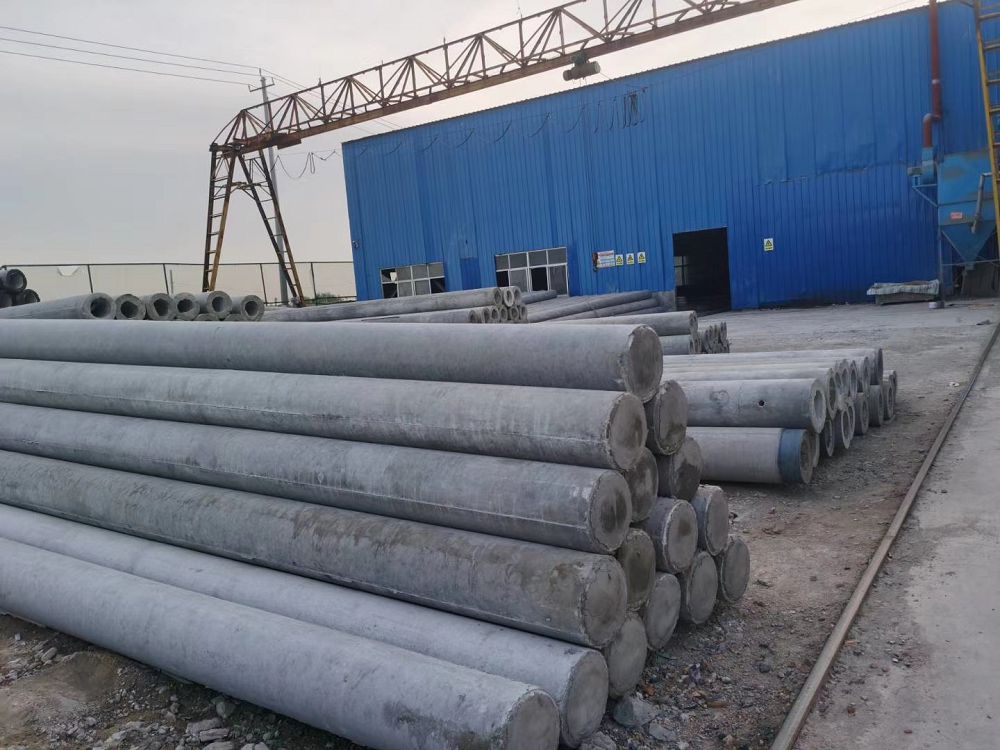
In professional terminology, a concrete utility pole is an annular concrete pole made of reinforced concrete. It is typically produced by centrifugal casting and is used to support overhead lines in power distribution and transmission, telecommunications, railways, and other infrastructure.
By reinforcement method, concrete poles can be divided into three main categories:
-
Ordinary reinforced concrete poles: Longitudinal reinforcement uses hot-rolled ribbed steel bars. No prestress is applied. The production process is relatively straightforward, and these poles are suitable for many distribution line applications.
-
Prestressed concrete poles: High-strength steel wires or strands are used as longitudinal reinforcement. Prestress is applied before concrete placement using the pretensioning method. This places the concrete in compression before external loads are applied, improving crack resistance and stiffness.
-
Partially prestressed concrete poles: These combine features of the two categories above. They provide a balance between load-carrying capacity, crack control, and ductility.
By shape, tapered poles usually have a smaller top diameter and a larger base diameter. A common taper is 1:75, which matches the bending moment distribution along the pole and can be economical when guy wires are not used. Constant-diameter poles have the same diameter along the length and can be economical when guy wires are used. Tapered poles commonly have top diameters from 100 mm to 230 mm. Constant-diameter poles commonly have diameters from 300 mm to 550 mm. Wall thickness is generally 30 mm to 60 mm.
2. Raw Materials: The Foundation of Performance
The performance of a concrete pole begins with raw materials.
Cement. Prestressed concrete poles often use Portland cement, ordinary Portland cement, or slag Portland cement with a strength grade not lower than 53.5 MPa. Sulfate-resistant cement may be used in aggressive soil or groundwater conditions. In certain production conditions, rapid-hardening Portland cement with a grade not lower than 43.5 MPa may also be used.
Different cement types have different hydration characteristics. Portland cement provides high early strength and fast hardening, which supports rapid mould turnover. Slag Portland cement has lower heat of hydration and better sulfate resistance, making it suitable for areas with high groundwater or corrosive soils. Sulfate-resistant cement is important in saline-alkali land and coastal areas.
Aggregates. Medium-coarse sand and crushed stone are selected with proper gradation to ensure workability and density. The water-cement ratio is a key parameter. During centrifugal casting, excess water is expelled by centrifugal force. This reduces the effective water-cement ratio and increases density and strength.
Reinforcement. The reinforcement system forms the “skeleton” of the pole. Prestressing tendons often use high-strength steel wires with tensile strength around 1,570 MPa and diameters around 3.6 mm. The number of wires may range from 11 to 30 or more, depending on design. Spiral reinforcement uses cold-drawn steel wire with strength around 650 MPa. It is wound around the longitudinal tendons to confine concrete, resist shear, and limit longitudinal cracks. Spacer rings are placed along the cage to keep tendons in position during casting and centrifugation.
3. Structural Design: Engineering the Load Path
Concrete pole design is not simply “steel plus concrete.” It requires calculation under multiple load cases.
A pole in service mainly carries three types of loads:
-
Vertical loads from the weight of conductors, ground wires, and accessories.
-
Horizontal loads from wind pressure on conductors and the pole itself.
-
Unbalanced tension under broken-wire conditions.
The annular section uses geometric symmetry to provide uniform bending resistance in all directions. This avoids the stress concentrations that can occur at the corners of square sections.
According to relevant standards, the concrete design strength grade for reinforced concrete poles should not be lower than C45. For prestressed and partially prestressed concrete poles, it should not be lower than C50. When the load class is M or above, C60 or higher concrete is often recommended.
In recent years, ultra-high-performance concrete (UHPC) has been developed for poles. Published technical literature and third-party test reports indicate that UHPC can reach compressive strengths of approximately 100 MPa to 150 MPa. Flexural strength may reach approximately 16 MPa to 25 MPa. UHPC also shows favorable performance in impermeability, carbonation resistance, chloride migration resistance, freeze-thaw resistance, and chemical resistance. These figures are indicative only. Actual values depend on mix design, production process, curing, and testing methods. Project-specific values should be confirmed by qualified testing.
The revision of structural design codes for annular section concrete poles has further improved design accuracy. New design parameters for C90 and C100 concrete have been introduced. The favorable effects of steel fibers on load-carrying capacity, crack development, and deflection control have also been considered. These advances help designers achieve safer and more efficient pole structures.
4. Conclusion
A concrete utility pole appears simple, but it is the result of careful material selection, reinforcement design, and structural calculation. From cement type and aggregate gradation to prestressing steel and annular section geometry, every detail affects performance. As a concrete pole manufacturer, we focus on consistent raw material control, precise reinforcement fabrication, and verified structural performance. This is how we support reliable power and communication infrastructure.